


 Cart
Cart
 sales@molnova.com



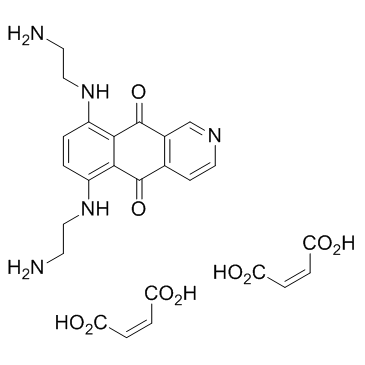
Pixantrone dimaleate
CAS No. 144675-97-8
Pixantrone dimaleate( BBR 2778 )
Catalog No. M11902 CAS No. 144675-97-8
Pixantrone dimaleate (BBR 2778 dimaleate) is an experimental antineoplastic drug.
Purity : >98% (HPLC)
 COA
Datasheet
HNMR
HPLC
MSDS
Handing Instructions
COA
Datasheet
HNMR
HPLC
MSDS
Handing Instructions
| Size | Price / USD | Stock | Quantity |
| 5MG | 42 | In Stock |


|
| 10MG | 65 | In Stock |
|
| 25MG | 120 | In Stock |
|
| 50MG | 205 | In Stock |
|
| 100MG | 312 | In Stock |
|
| 500MG | 743 | In Stock |
|
| 1G | Get Quote | In Stock |
|
Biological Information
-
Product NamePixantrone dimaleate
-
NoteResearch use only, not for human use.
-
Brief DescriptionPixantrone dimaleate (BBR 2778 dimaleate) is an experimental antineoplastic drug.
-
DescriptionPixantrone dimaleate (BBR 2778 dimaleate) is an experimental antineoplastic drug.(In Vitro):Pixantrone (0-10 μM, 72 h) dimaleate induces cell death in multiple cancer cell lines independent of cell cycle perturbation, with IC50s of 37.3 nM, 126 nM and 136 nM for T47D, MCF-10A and OVCAR5 cells, respectively.Pixantrone (25-500 nM, 2 4 h) dimaleate induces DNA damage at high concentration of 500 nM and induces severe chromosomal aberrations and mitotic catastrophe in PANC1 cells.Pixantrone (100 nM, 24 h) dimaleate may disrupt chromosome segregation because of generating merotelic kinetochore attachments that cause chromosome non-disjunction.Pixantrone (0-100 μM, 72 h) dimaleate potently inhibits growth of human leukemia K562 cells, etoposide-resistant K/VP.5 cells, MDCK and ABCB1-transfected MDCK/MDR cells with IC50s of 0.10 μM, 0.56 μM, 0.058 μM and 4.5 μM, respectively.Pixantrone (0.01-0.2 μM) dimaleate leads to a concentration-dependent formation of linear DNA through acting on topoisomerase Iiα and produces semiquinone free radicals in an enzymatic reducing system, although not in a cellular system, most likely due to low cellular uptake.Pixantrone (0.01-10 μM) dimaleate shows potent inhibitory activities against rat 97-116 peptide-specific T cell proliferation.(In Vivo):Pixantrone (i.v., 27 mg/kg, every 7 days, three times) dimaleate does not worsen pre-existing moderate degenerative cardiomyopathy, causes minimal cardiotoxic in mice following repeated treatment cycles and results in less mortality than mitoxantrone in doxorubicin-pretreated mice.Pixantrone (i.v., 16.25 mg/kg, every week, three times) dimaleate modulates Lymph node cells (LNC) responses, affacts T cell subpopulations in TAChR-immunized Lewis rats and also shows preventive and therapeutic effect in experimental autoimmune myasthenia gravis (EAMG) rats.
-
In Vitro——
-
In Vivo——
-
SynonymsBBR 2778
-
PathwayOthers
-
TargetOther Targets
-
RecptorOthers
-
Research AreaCancer
-
Indication——
Chemical Information
-
CAS Number144675-97-8
-
Formula Weight557.21
-
Molecular FormulaC25H27N5O10
-
Purity>98% (HPLC)
-
SolubilityDMSO: 10 mM
-
SMILESC1=CC(=C2C(=O)C3=C(C(=O)C2=C1NCCN)C=CN=C3)NCCN.C(=C\C(=O)O)\C(=O)O.C(=C\C(=O)O)\C(=O)O
-
Chemical Name——
Shipping & Storage Information
-
Storage(-20℃)
-
ShippingWith Ice Pack
-
Stability≥ 2 years
Reference
1.Cavalletti E., et al. Invest New Drugs, 2007. 25(3): p. 187-95.
molnova catalog



related products
-
SV40 T-Ag-derived NL...
This peptide, a nuclear localization signal DNA tagged to this peptide efficiently translocates into the cell nucleus.
-
Dihydrofluorescein d...
Dihydrofluorescein diacetate is a fluorescent probe for measuring oxidative stress in cell-free systems and cellular models.
-
IRE1α kinase-IN-1
IRE1α kinase-IN-1 is a highly selective IRE1α (ERN1) inhibitor, with an IC50 of 77 nM. It displays 100-fold selectivity for IRE1α over the IRE1β isoform.
